
Flyout Menu
SEARCH
“Working simultaneously in the educational department of The Metropolitan Museum of Art, the American Museum of Natural History, and the American Craft Museum made me wonder about how the environment in which cultural production is placed affects the way the viewer feels about the artwork and the artist who made these things.”
Fred Wilson
In 1992, Fred Wilson created the now historic installation, “Mining the Museum” (organized by the Contemporary and at the Maryland Historical Society, both in Baltimore). The same year, the artist had his second solo presentation at the New York gallery, Metro Pictures. There, he created an installation titled, “Panta Rhei – A Gallery of Ancient Classical Art.” The work currently on view at Krakow Witkin Gallery is from this 1992 body of work.
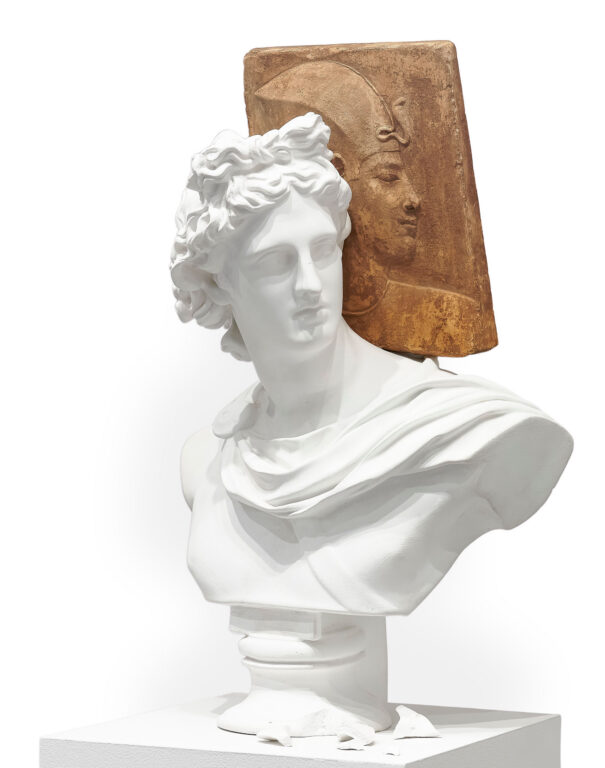
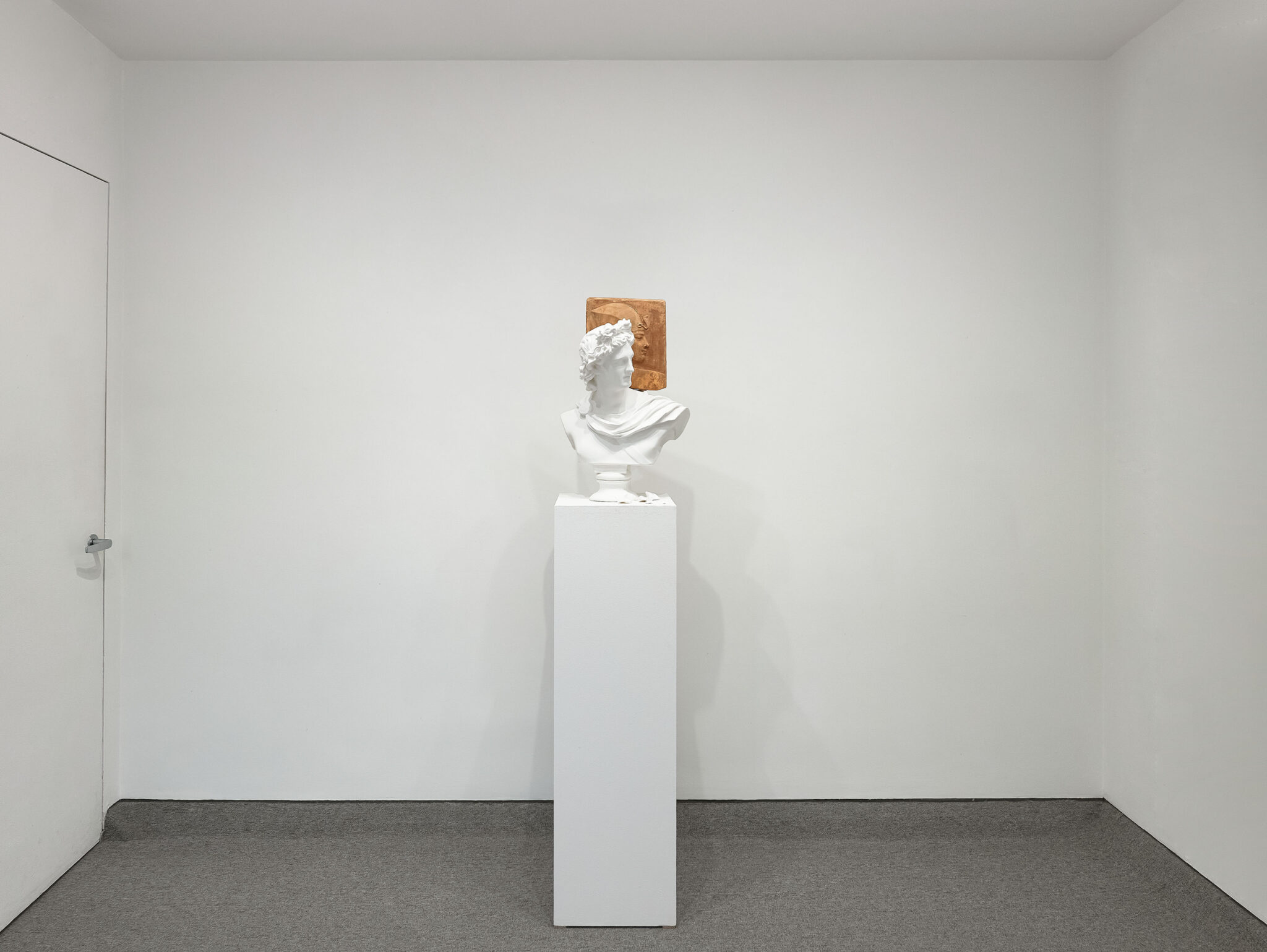
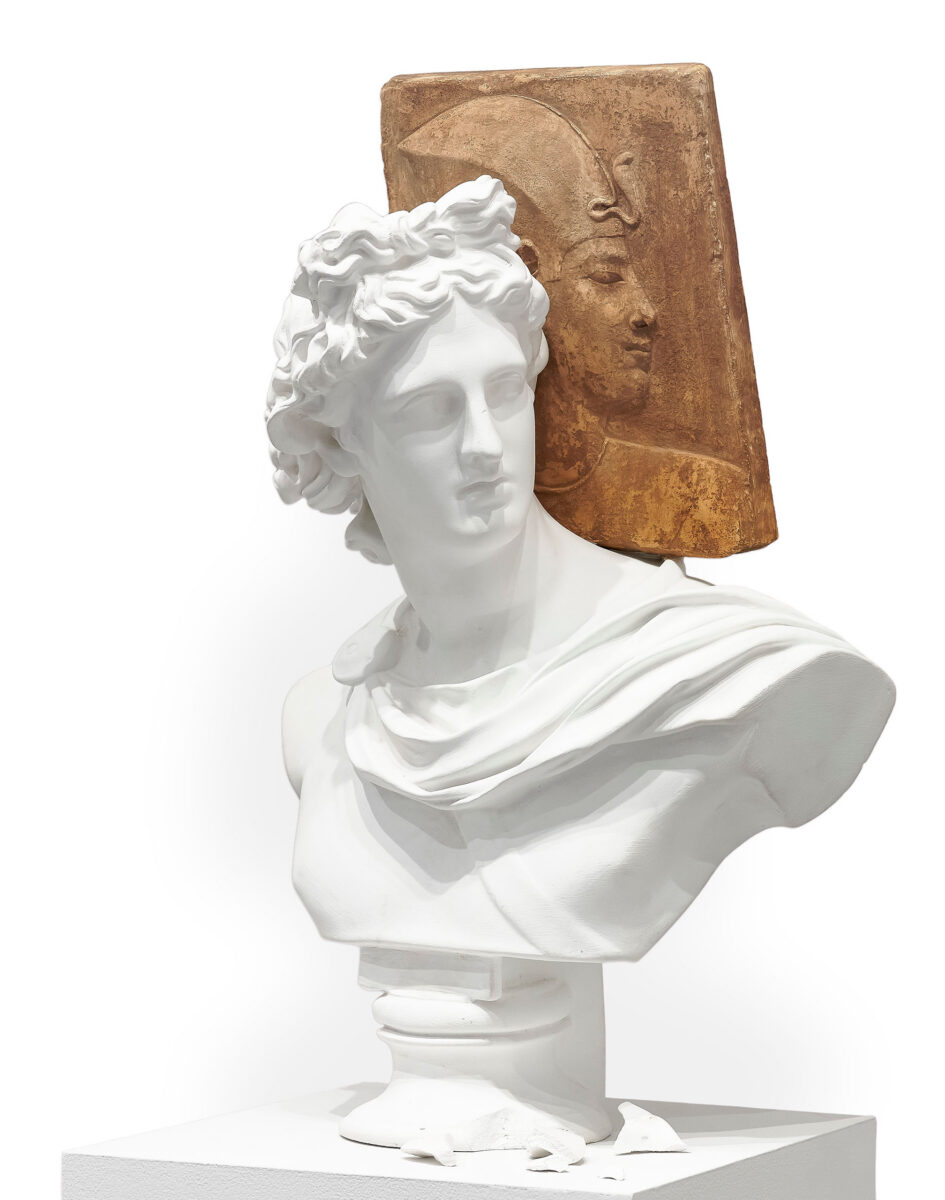
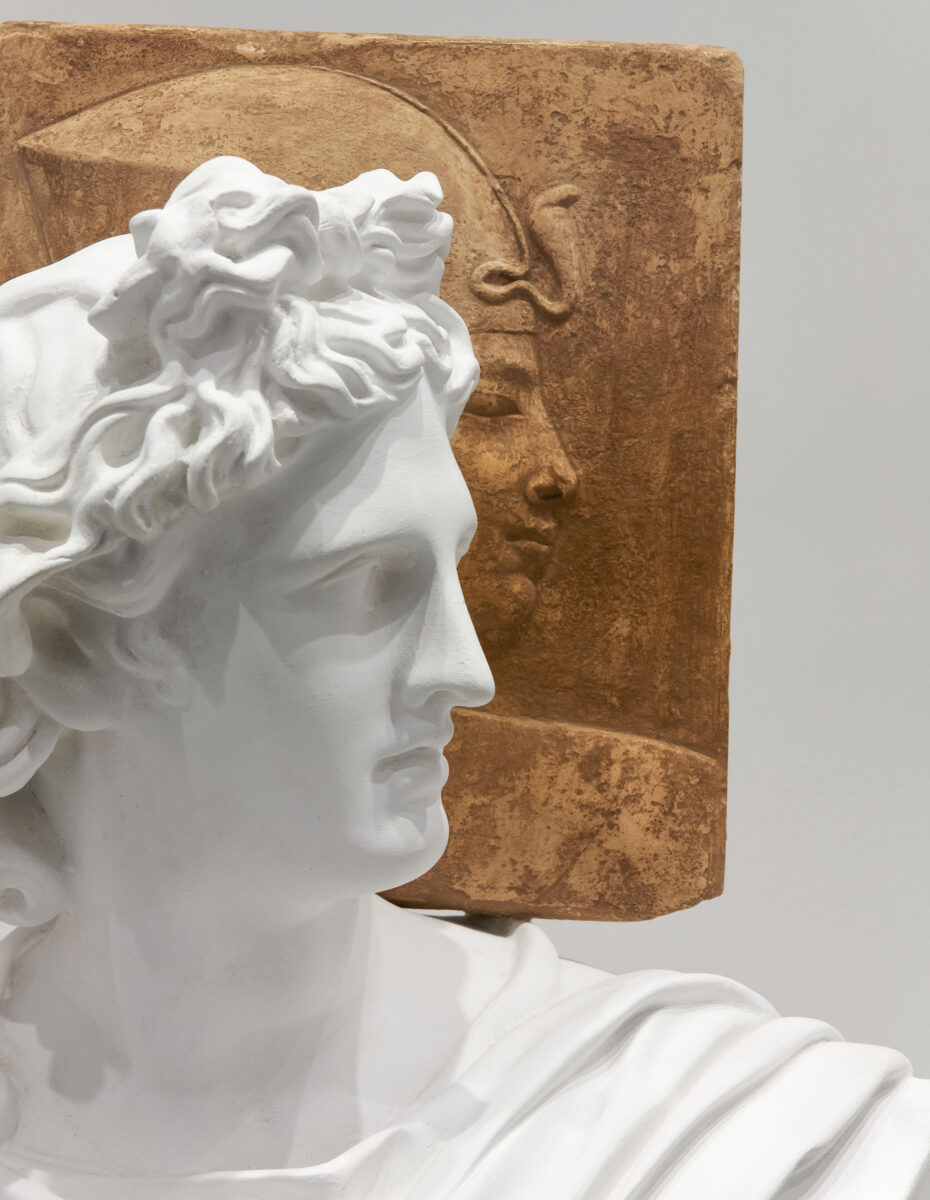
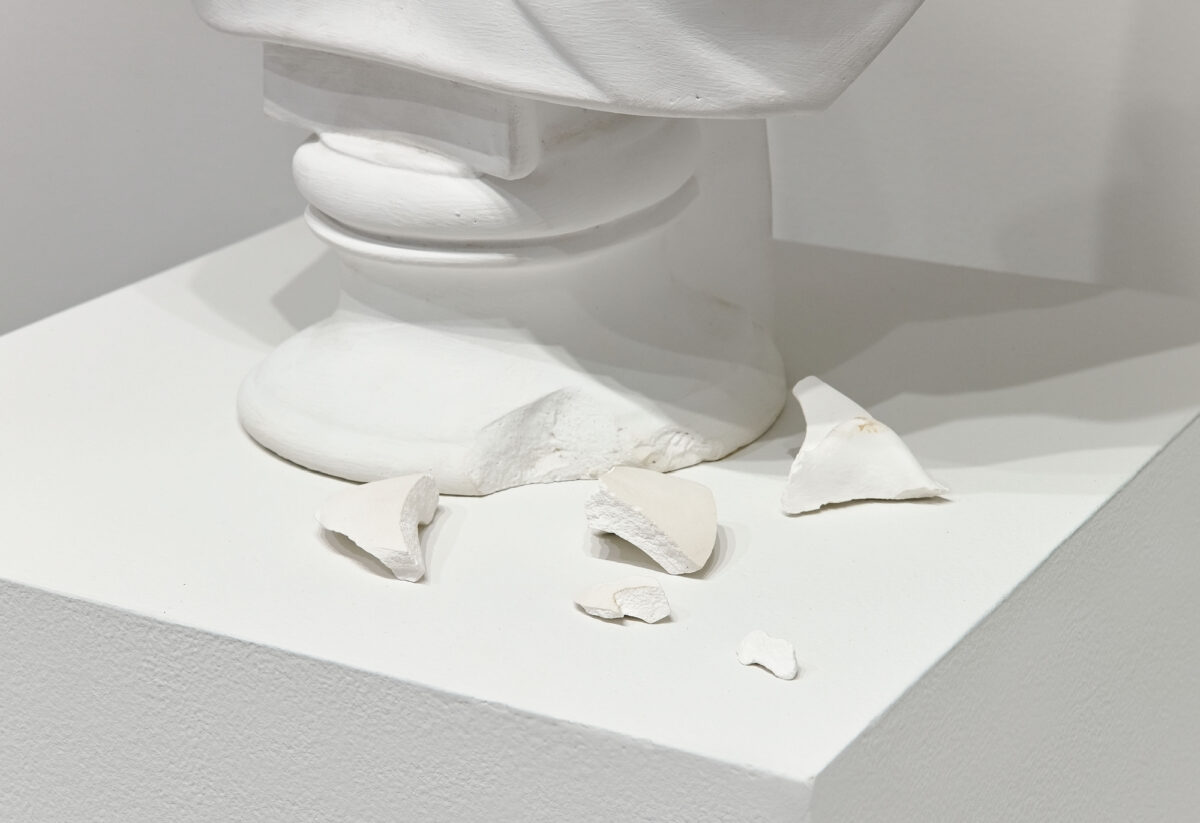
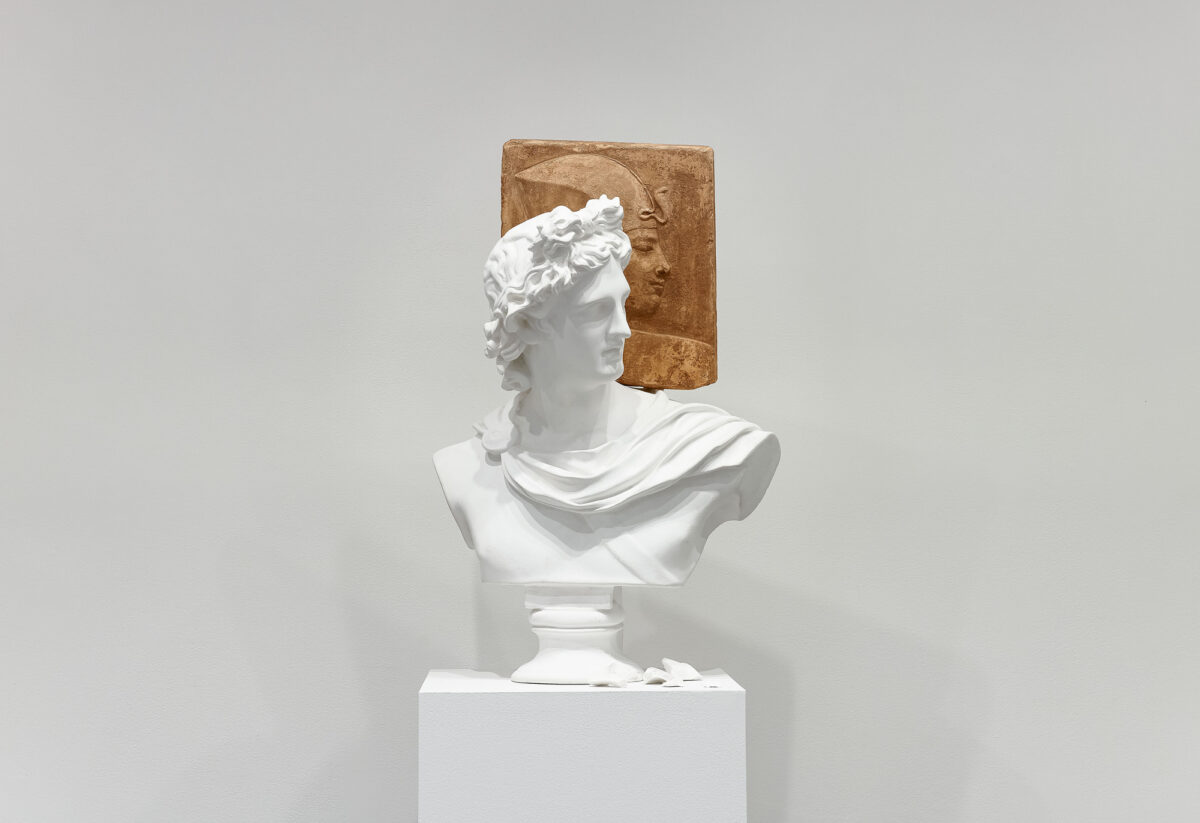
The untitled piece currently on view situates, together, a plaster bust reproduction of the Apollo Belvedere (a 2nd century A.D. Roman copy of a 3rd century B.C. Greek original that depicts the deity) with a plaster cast reproduction of a low relief image of what is most likely a Pharaoh from around 400-200 B.C. Key to Wilson’s work is not only the juxtaposition of sculptures of these two figures from different cultures, but also the continually changing reception of and knowledge about both figures. The art historian Kenneth Clark (1903–1983) once remarked about the Apollo Belvedere sculpture (on permanent view at the Vatican), “…for four hundred years after it was discovered, the Apollo was the most admired piece of sculpture in the world. It was Napoleon’s greatest boast to have looted it from the Vatican. Now it is completely forgotten except by the guides of coach parties, who have become the only surviving transmitters of traditional culture.” Meanwhile, the plaque-like form that Wilson chose to juxtapose the Apollo with is of a type that is still rather mysterious to historians in terms of its use as it is a roughly formed, small-scale object whose subject, while most likely a Pharaoh or demi-god, is not defintively known.
The juxtaposition of the two reproductions, the two visages, the in-the-round with low relief, the iconic and what is lost to time, the color differences, and the cultural origins of each can, of course, lead to a discussion of differences, precursors, influence, power, history, and memory. It can also lead to thoughts like that of “Panta Rei” (the title of Wilson’s 1992 gallery exhibition). “Panta Rhei” translates from Ancient Greek as “everything flows” and is a summary of Heraclitus’ thought ca. 500BC that explores ideas such as, “You cannot step into the same river; for fresh waters are ever flowing in upon you.”
The press release for Wilson’s 1992 Metro Pictures exhibition states, “Wilson considers the issue of Africa’s participation in the early developments of Western civilization through an exploration of the etiology of Greco-Roman culture and myth, and in particular its Egyptian origins. Concentrating on Egypt’s religious and cultural connections to Greco-Roman mythology, and its geographic location in the northeast of the African continent, Wilson addresses the traditional, delimiting view of Western culture as it is generally represented. The well-known exchange of goods and culture between the civilizations of Sub-Saharan Africa, Egypt and Greece is not clearly represented in other than scholarly versions of the sources of Western civilization.”
Reading this text 34 years later, one acknowledges that much has changed and yet much more still needs to. Wilson has said that “as an artist, I am interested in the movement of ideas during this ancient period. I do not pretend to promote a scholarly, absolute viewpoint. I am interested in re-examining familiar attitudes with regard to the history of the world, given the historic and documented biases of past generations.”
For Wilson, in 1992 and in his work ever since, there is a balance between criticality, knowledge, openness, and hope. By using the convention of a standard museum presentation, the artist explores the selective presentation of historical and cultural information all with an eye to better understand the past (from whence the imagery first appeared all the way thorough the various eras of re-finding, research, reproduction, reawakening, and reevaluating) and to help guide to a better future.
Fred Wilson (b. 1954, Bronx, New York) has long investigated the meanings of symbols and objects as part of his multidisciplinary, research-based practice. Through alteration, juxtaposition, decontextualization, and selection, among other actions, the artist provides opportunities for new interpretations and associations that reframe social and historical narratives. Working across sculpture, painting, photography, collage, printmaking, and installation, Wilson imbues reclaimed images and objects with personal and historical importance. Legacies of colonialism and erasures of Blackness in Western European art are often the initial subject in his exchanges with these objects of different geographic and temporal origins, thought the work speaks to legacies and evolutions, as well.
23 1/2 x 15 3/4 x 11 inches (59.7 x 40 x 27.9 cm)
(Inventory #36966)
23 1/2 x 15 3/4 x 11 inches (59.7 x 40 x 27.9 cm)
(Inventory #36966)
No results found.