
Flyout Menu
SEARCH
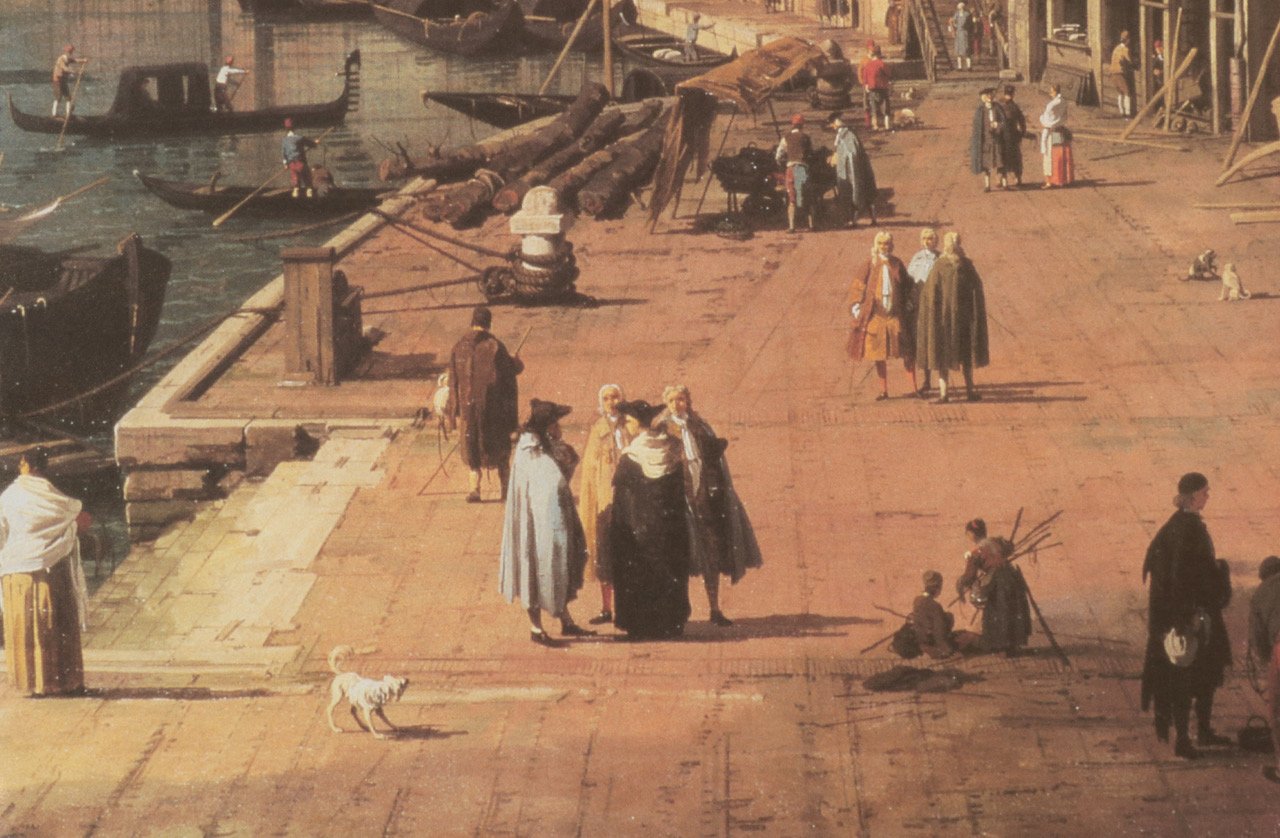


In 2002, Joseph Grigely was included in a show curated by Ralf Biel at the Kunstmuseum Bern. The artist utilized the permanent collection and the museum itself to create an installation that focused on works that represented sound in alternative, visual ways. As part of the project, the artist wrote the essay, “23 footnotes on sound in Kunstmuseum Bern.” Below is footnote #13:
“Canaletto painted one of his Schiavoni paintings—“The Riva degli Schiavoni: a view of Venice Looking West”– in 1736. The painting is now in the Sir John Soane’s Museum, London. It’s a very conventional Canaletto of the sort he painted for the English tourist crowd. Whether he was painting a palazzo or a lido, Canaletto typically filled his canvases with small groups of people who seem to be chatting, people who seem to yell, and people whose gestures bespeak directions. It’s usually the dogs that give away the paintings’ intimate secret: it is not just a visual scene being represented—a visual experience—but the human occupation of that expanse, and the fact that this occupation is characterized not by things seen, but by the subtlety of things heard. Canaletto is a noisy painter, but noisy in a way that does not require histrionics. You can hear it in the foreground of his Schiavoni painting, where a dog’s head is cocked to the conversation of a cluster of people a few steps away; nearby, a bargeman gestures and yells loudly enough to capture the attention of a woman walking by. Canaletto’s dogs have nothing of the grace of Gainsborough’s or the sleek eloquence of the Berner Nelkenmeister’s; they’re street-smart stragglers that both make noise and, with a turn of their head and ear, point it out to us.”
The current exhibition presents a sculpture that embodies these ideas and enters the viewer’s physical space, pointing out what is and what is not there.