
Flyout Menu
SEARCH
Text: Truisms (1977-79) and Survival (1983-85)
9 3/8 x 68 x 2 3/8 inches (23.6 x 173 x 6.1 cm)
Edition of 6
Signed and numbered on reverse
(Inventory #31516)
Text: Truisms (1977-79) and Survival (1983-85)
9 3/8 x 68 x 2 3/8 inches (23.6 x 173 x 6.1 cm)
Edition of 6
Signed and numbered on reverse
(Inventory #31516)
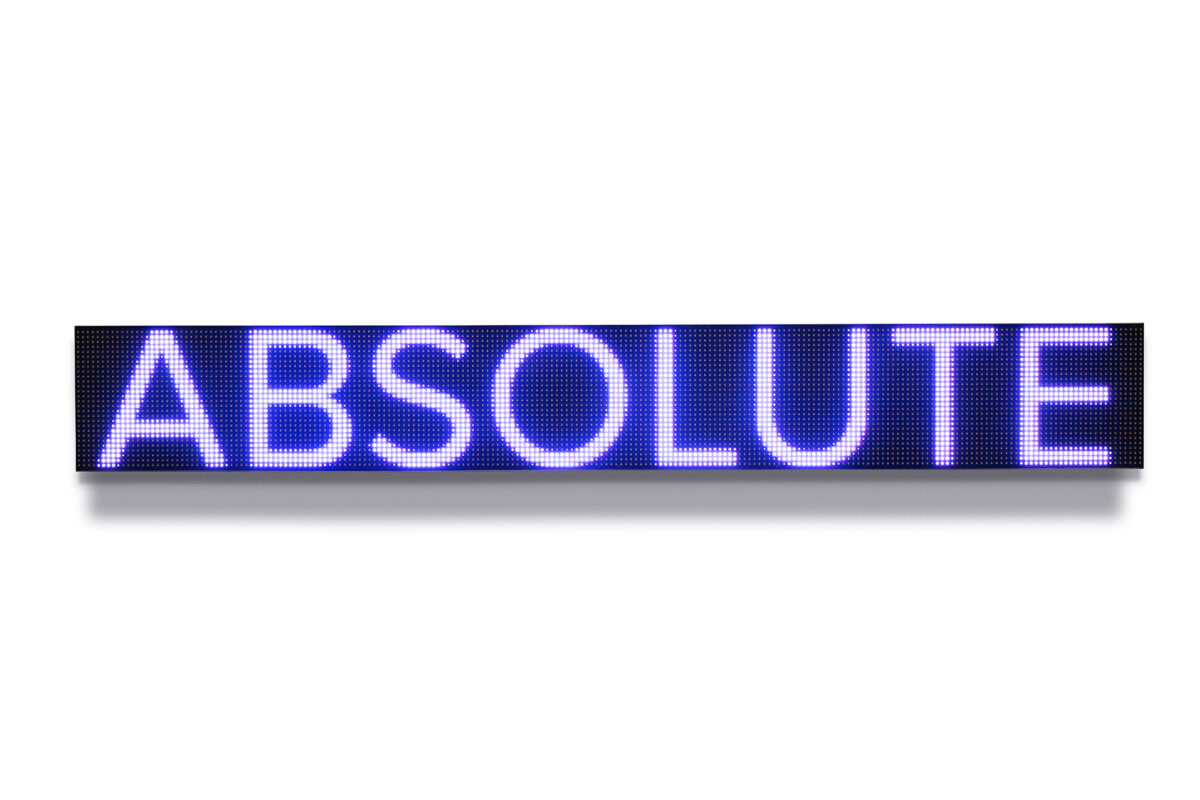
Jenny Holzer’s “Pearl’s Truisms & Survival” incorporates excerpts from two bodies of texts, Truisms and Survival, and has been programmed with a variety of different “movements.”
TRUISMS (1977–79)
The Truisms, comprising over 250 single-sentence declarations, were written to resemble existing aphorisms, maxims, and clichés. The series was influenced by the reading list provided by Ron Clark at the Whitney Independent Study Program, where Holzer studied in 1977. Each sentence distills difficult and contentious ideas into a seemingly straightforward statement of fact. Privileging no single viewpoint, the Truisms examine the social construction of beliefs, mores, and truths. Arranged in alphabetical order, they were first shown on anonymous street posters pasted throughout downtown Manhattan, and they have since appeared on T-shirts, hats, electronic signs, stone floors, and benches.
SURVIVAL (1983–85)
Survival is a cautionary series whose sentences instruct and inform while questioning the ways individuals respond to their political, social, physical, psychological, and personal environments. The tone of Survival is more urgent that that of Living. Survival was the first of Holzer’s text series to be written especially for electronic signs; the sentences are short and pointed so as to be easily accessible to passersby. PROTECT ME FROM WHAT I WANT is a key text from this series.
LEDs
Holzer has employed LED technology since 1983, when she created her first editions of LED signs. While LED displays typically disseminate news, information, or advertisements, Holzer uses the medium to present messages that are more ambiguous and challenging. The texts are rendered in a range of colors and effects meant to evoke a variety of moods, turning reading into a physical presence, the experience into an almost dreamlike state. Holzer has noted that “a great function of the signs is their capacity to move, which I love because it’s so much like the spoken word. You can emphasize, you can roll and pause, which is the kinetic equivalent to inflection in the voice.”