

Flyout Menu
SEARCH
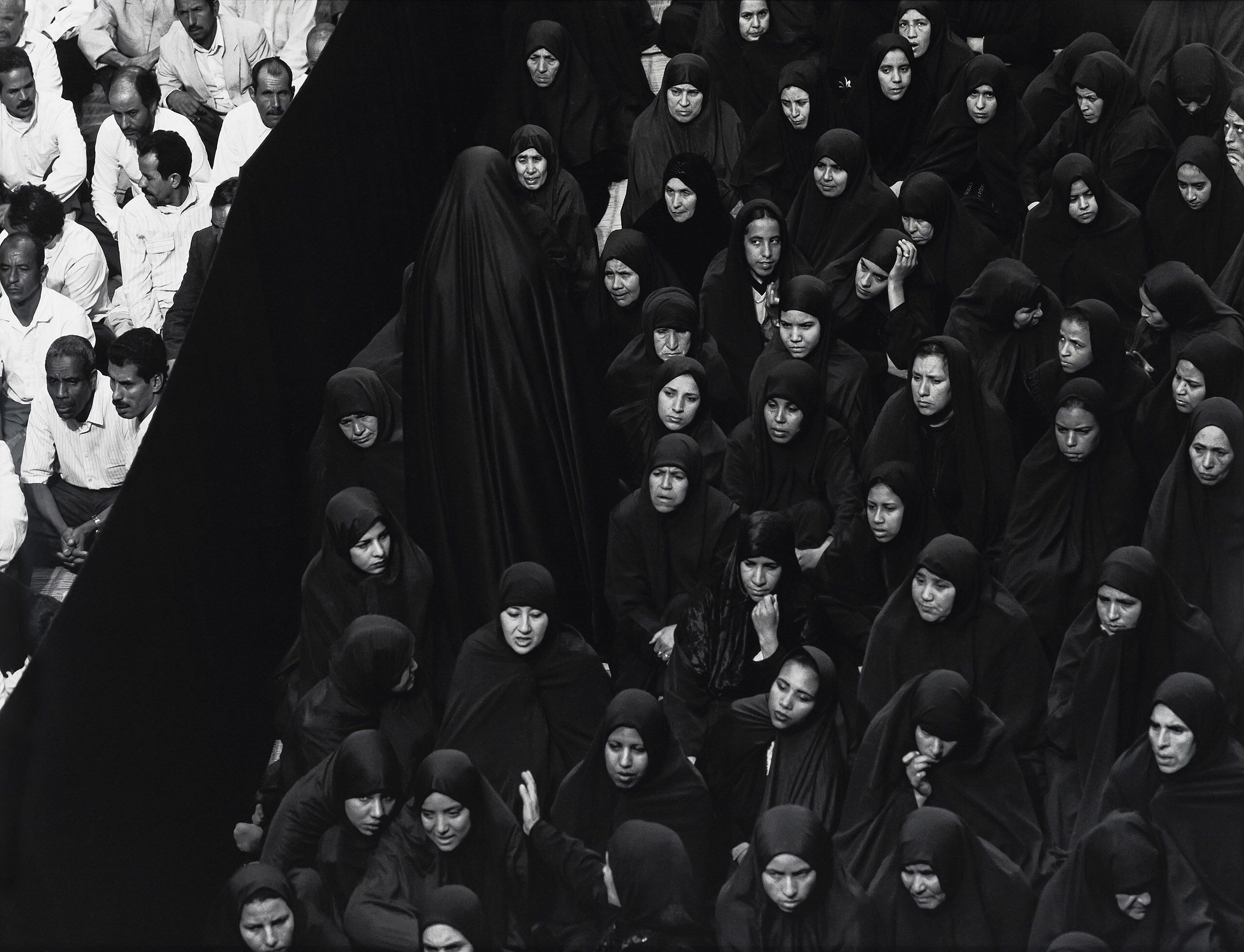
“Fervor […] focuses on the problematic of temptation and desire, and the ways in which sexual taboos are so deeply internalized that men and women often experience a conflict between their natural, biological tendencies and their moral and religious ideas.”
– Shirin Neshat
In her trilogy of films, “Turbulent,” “Rapture,” and “Fervor,” created between 1998 and 2000, Shirin Neshat chose to present each work on two screens, in such a way that the narratives unfolded simultaneously from parallel gender perspectives. Far from uniform or static, in the films and the related photographic works, Neshat’s groups of women and men bristle with individual energies and continuously reshape themselves to form webs of interrelationships, that extend between and beyond image planes to implicate the viewer in their sensually charged dynamics.
The photograph on view, from the Fervor series, “Crowd from front, woman leaving” (2000), references a culminating moment of tension in the film, when adjacent male and female audiences, separated by a black curtain, have been whipped into a frenzy by an orator’s cautionary parable about sexual desire and begin to passionately curse the devil. As the crowd’s zeal builds to a climax, a single woman stands up and walks out. The solitary woman has turned her back, clad in a full-length black chador, so that she is visible less as a figure than as a void in the crowd of women seated around her.
The simple visual device enacts at once an effacement of one woman’s presence in the moment—be it a shameful escape or perhaps a cathartic liberation—and a refocusing of the viewer’s attention to the dozens of faces still turned toward the camera. The photograph, staged separately from the film, describes this moment in the vocabulary of a painting, where the narrative plays out across the image plane rather than through movement. The elevated point of view arrays the rows of women—and the men across the divide—into a silent tableau of individual gestures, conversations, and thoughts. The rigid, public edifices of moral control and political agenda fracture into a mosaic of the sensual and the private.
Exhibited facing the Fervor photograph is a work from Neshat’s 1993–1997 project “Women of Allah.” Titled “Way in Way out” (1995), it presents a complementary exploration of the boundaries of personal and political space. The artist created this series of work in response to her first trip home to Iran after decades spent overseas in the wake of the 1979 revolution. Often posing herself as the subject, Neshat set up confrontational, yet deeply intimate photographic compositions that contrast the covering of the female body in the chador with selectively exposed faces, hands and feet, which she embellishes with calligraphy and ornamental motifs.
The subject of the exhibited work, clad entirely in white, kneels in the traditional posture of Islamic prayer, while a black rifle lays at her side. Running up the hem of her robe, Neshat has inscribed a fragment of a piece by modern Iranian poet Tahereh Saffarzadeh, which exclaims, “O! that I could hold a hand!” The work is intended to be read on multiple levels by different audiences: where one viewer might read religious militancy, another might connect the woman’s expression and gesture with the sense of longing in the text. Neshat returns continuously to the contradictions inherent in the viewer’s assumptions and the setting of the subject to activate narratives of memory and desire. Out of polemics she creates individual pathways to discovery and liberation.
“A documentary records a truth; a work of art finds ways of presenting to the mind what cannot be shown directly.”
– Arthur C. Danto

Image size: 46 x 63 1/4 inches (116.8 x 160.7 cm)
Frame size: 49 5/8 x 66 5/8 inches (126 x 169.2 cm)
Signed, dated, titled, and numbered verso
Edition of 5
(Inventory #40292)
Image size: 46 x 63 1/4 inches (116.8 x 160.7 cm)
Frame size: 49 5/8 x 66 5/8 inches (126 x 169.2 cm)
Signed, dated, titled, and numbered verso
Edition of 5
(Inventory #40292)


Image size: 47 3/4 x 60 3/16 inches (121.3 x 152.9 cm)
Frame size: 47 5/8 x 60 1/4 inches (121 x 153 cm)
Signed, dated, and numbered verso
Edition 1 of 5, 2 AP
(Inventory #40291)
Image size: 47 3/4 x 60 3/16 inches (121.3 x 152.9 cm)
Frame size: 47 5/8 x 60 1/4 inches (121 x 153 cm)
Signed, dated, and numbered verso
Edition 1 of 5, 2 AP
(Inventory #40291)
No results found.