Sol LeWitt

Selected Works
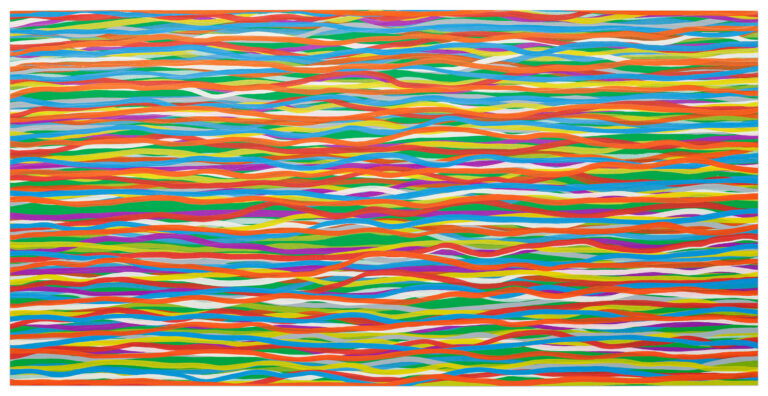
Horizontal Wavy Brushstrokes in Color
2006
Unique linocut monoprint

Image/paper size: 24 x 48 inches (61 x 121.9 cm)
Signed ‘LeWitt’ lower right in graphite
(Inventory #38300)

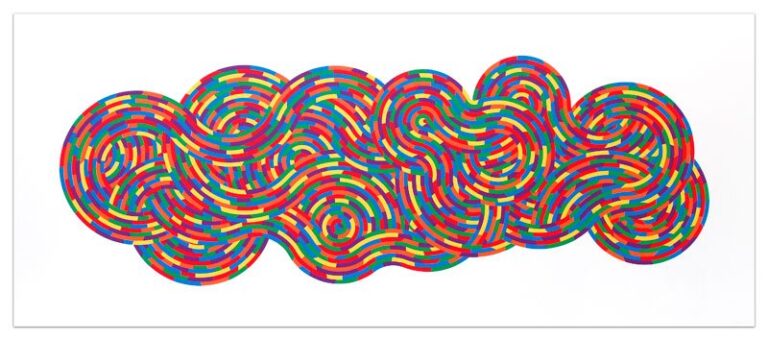
Whirls and Twirls (color)
2005
Linocut

Edition of 50
Image size: 15 7/8 x 46 inches (40.3 x 116.8 cm)
Paper size: 22 1/2 x 52 3/4 inches (57.2 x 134 cm)
Signed and numbered lower right in graphite
(Inventory #38399)

Lines in Four Directions in Color on Color
2005
Set of six linocuts

Image size: 3 3/4 x 12 3/4 inches each (9.5 x 32.3 cm each)
Paper size: 9 7/8 x 18 7/8 inches each (25.1 x 47.9 cm each)
Edition of 75, 8 AP, 4 PP
Signed ‘LeWitt’ and numbered lower right in graphite on each sheet
(Inventory #38395)

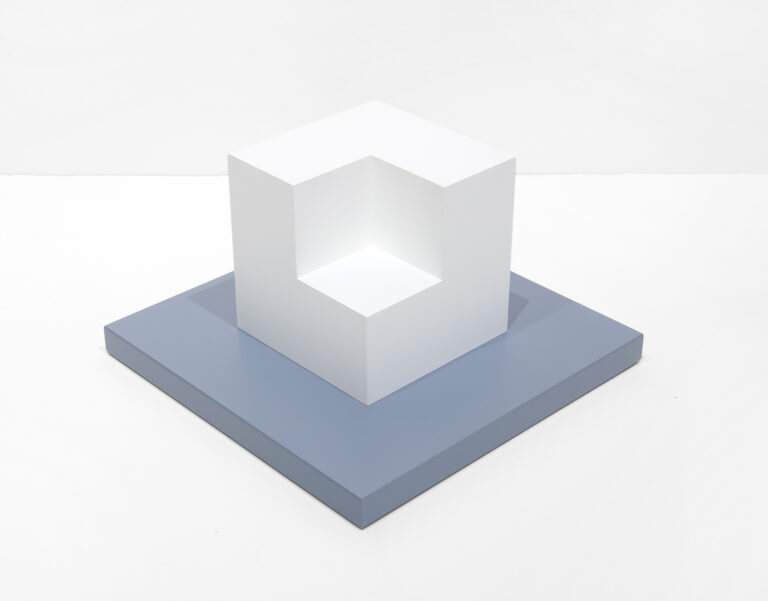
Cube Without A Cube
2005
Shaped from solid slabs of syntactic polyurethane and painted in lacquer

Structure is 6 x 6 x 6 inches on a base measuring 12 x 12 x 1 inches
Edition of 6
Signed and numbered on bottom of base
(Inventory #35877)

Six Cube Variations
2005
Acrylic on lacquer painted base

Edition of 6
8 x 7 1/4 x 33 inches
Each variation: 2 x 2 x 6 inches
Base: 33 x 8 x 1 inches
Signed and numbered on bottom of base
(Inventory #35879)

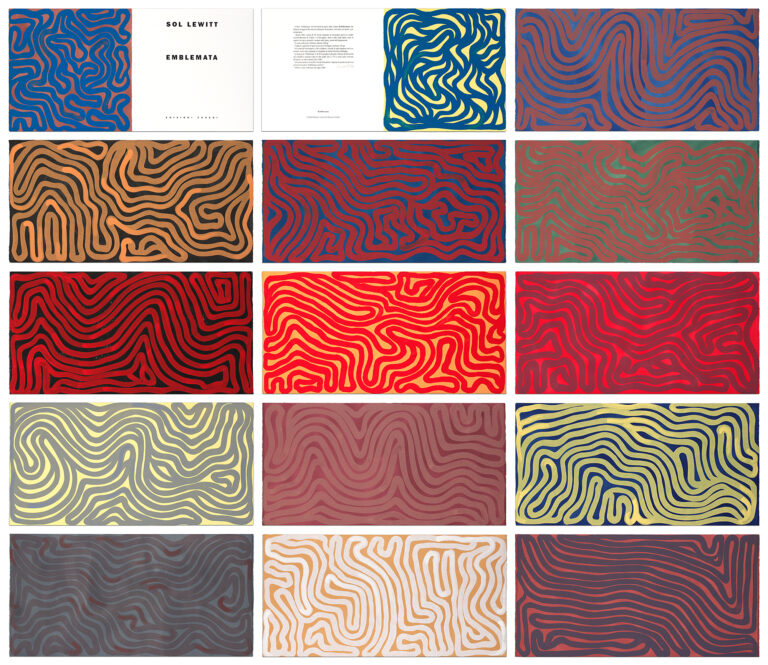
Emblemata
2000
Set of fifteen monotypes with colophon page

Edition of 70
Image/paper size: 11 1/4 x 22 3/8 inches each (28.6 x 56.8 cm each)
Signed and numbered on colophon page
(Inventory #33878)

Parallel Curves
2000
Lithograph with etching aquatint

Images size:  24 x 24 inches  (61 x 61 cm)
Paper size:  36 x 36 inches  (91.4 x 91.4 cm)
Edition of XXX
Signed and numbered lower right
(Inventory #35756)
Krakow 2000.02

Loops & Curves Red/Yellow
1999
Etching aquatint with color sugar lift aquatint

Image size: 35 3/4 x 22 1/4 inches (90.8 x 56.5 cm)
Paper size: 40 x 26 1/2 inches (101.6 x 67.3 cm)
Edition of 20, 10 AP
(Inventory #38779)

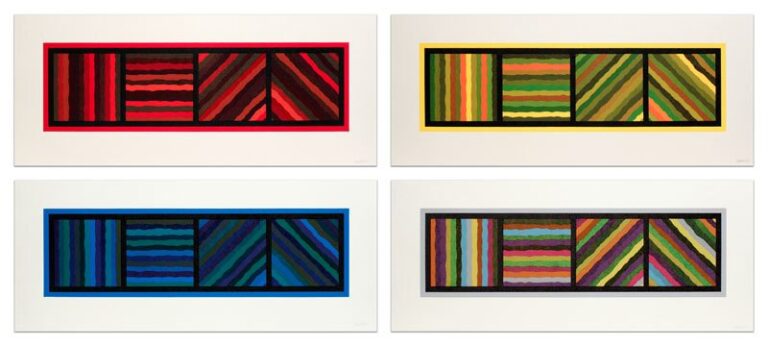
Bands (Not Straight) in Four Directions
1999
Set of four oil-based woodcuts

Image size: 8 1/2 x 29 1/2 inches each (21.6 x 75 cm each)
Paper size: 14 3/4 x 35 inches each (37.5 x 88.9 cm each)
Signed and numbered on lower right in graphite
Edition of 75
(Inventory #40063)
Krakow 1999.01

Parallel Curves
1999
Gouache on paper, unique

Image/paper size: 15 x 15 inches (38.1 x 38.1 cm)
Frame size: 16 1/4 x 16 1/4 inches (41.3 x 41.3 cm)
Signed and dated lower recto
(Inventory #40298)

Eight Small Etchings/Color
1999
Set of eight color hard ground etchings

Edition of 40
Image size: 4 x 4 inches each (10.2 x 10.2 cm each)
Paper size: 8 x 8 inches each (20.3 x 20.3 cm each)
Signed and numbered lower right in graphite on each sheet
(Inventory #34000)

Loopy Doopy
1998
Ink on paper

Paper size: 29 1/2 x 34 1/4 inches (74.9 x 87 cm)
Frame size: 36 x 41 inches  (91.4 x 104.1 cm)
Signed and dated lower right in graphite
(Inventory #34342)

Wall Drawing #848: A wall bordered and divided vertically and horizontally by a flat gray band into four equal parts, each divided by a curvy line. Top left, divided vertically. Left: glossy black; right: flat white. Top right, divided horizontally. Top: glossy red; bottom: flat orange. Bottom left, divided diagonally from left to right. Left: flat purple; right: glossy blue. Bottom right, divided diagonally from right to left. Left: flat green; right: glossy yellow
1998
Acrylic paint

First drawn by: Sachiko Cho, Kevin Oster
First installation: Jo Watanabe and Sachiko Cho residence, New York
June 1998
Acrylic paint
Installation dimensions are variable
Signed on accompanying certificate
(Inventory #38291)

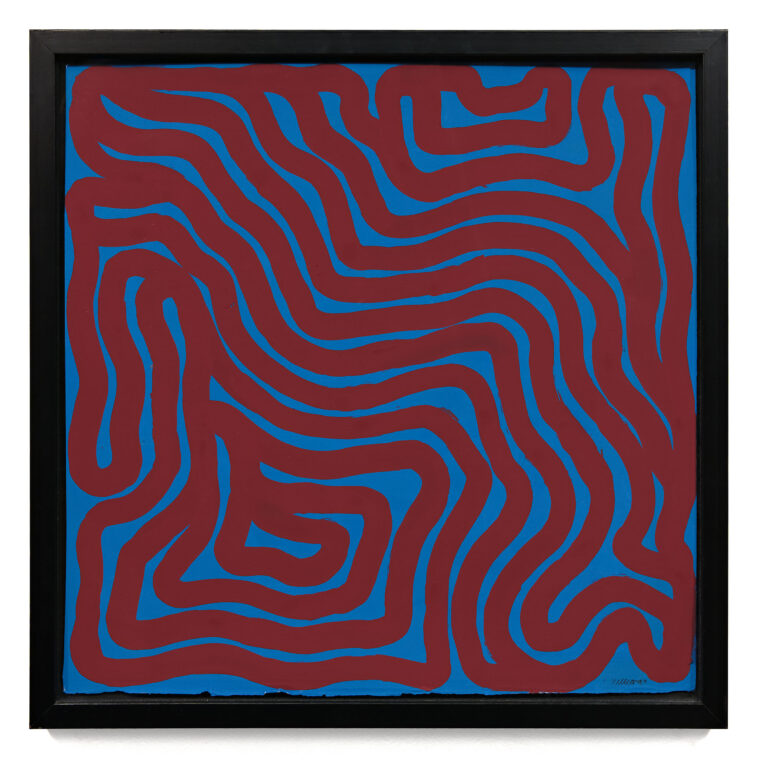
Squiggly Lines (Lines Not Straight, Not Touching, Black on Blue)
1997
Unique silkscreen monoprint

Image/paper size: 56 x 56 inches (142.2 x 142.2 cm)
Annotated and signed ’28/S.LeWitt’ lower right
(Inventory #27104)

Bands of color in Different Directions (Diptych)
1996
Etching with aquatint on two sheets of wove paper

Image size: 13 x 75 3/4 inches overall (33 x 192.4 cm overall)
Plate size: 14 x 77 inches overall (35.56 x 195.6 cm overall)
Paper size: 20 x 82 3/4 inches overall (50.8 x 210.2 cm overall)
Edition of 36, 8 AP
Signed and numbered lower right on right sheet
(Inventory #38745)

Irregular Bands with Colors Superimposed/Irregular Bands Black and Gray
1994
Set of two woodcuts

Image size: 26 x 39 1/2 inches each (66 x 100.3 cm each)
Paper size: 29 1/2 x 42 1/2 inches each (74.9 x 108 cm each)
Edition of 25
Signed and numbered lower right on each sheet in graphite
(Inventory #38667)

Wavy Brushstrokes
1994
Gouache on paper, unique

Paper size: 22 3/16 x 29 3/4 inches (56.4 x 75.6 cm)
Frame size: 26 3/4 x 34 1/8 inches (67.9 x 86.7 cm)
Signed and dated lower right recto
(Inventory #38294)

Cube
1991
Gouache on paper, unique

Image size: 20 1/2 x 28 1/4 inches (52.1 x 71.8 cm)
Paper size: 22 x 29 3/4 inches (55.9 x 75.6 cm)
Frame size: 24 5/8 x 32 1/4 inches (62.5 x 81.9 cm)
Signed and dated ‘S. LeWitt 91’ lower right in graphite
(Inventory #30989)

Fifteen Equal Arcs from the Midpoint of the Bottom, with All One, Two, Three and Four part Combinations of Four Colors
1990
Etching with aquatint

Image size: 31 x 12 7/8 inches (78.7 x 32.7 cm)
Paper size: 36 1/2 x 18 1/2 inches (92.7 x 47 cm)
Edition of 30
Signed and numbered lower right
(Inventory #35451)

Complex Form with Black and White Bands
1988
Silkscreen

Image/paper size: 40 x 55 inches (101.6 x 139.8 cm)
Edition of 100, 16 AP, 3 PP
Signed and numbered lower right in graphite
(Inventory #39146)

All One, Two, Three & Four-Part Combinations of Four Transparent Colors
1985
Color silkscreen

Edition of 35
Image size: 35 1/2 x 32 inches (90.2 x 81.3 cm)
Paper size: 38 1/4 x 36 inches (97.2 x 91.4 cm)
Signed and numbered lower right in graphite
(Inventory #35439)

Cube
1979
Paint on aluminum

Edition of 35
11 x 11 x 11 inches (27.9 x 27.9 x 27.9 cm)
Engraved stamped signature, edition and date with fabricators stamp on bottom
(Inventory #33179)

Bands of Lines One Inch Wide in Four Directions & Four Colors
1985
Silkscreen

Image/plate size: 23 1/8 x 89 1/8 inches (58.7 x 226.4 cm)
Paper size: 29 x 95 inches (74 x 241.3 cm)
Edition of 20, 6 AP, 2 PP
Signed and numbered lower right
(Inventory #39440)

Maquette for Project (Wall Project, Chicago, Illinois)
1983
White painted wood multiple

24 x 18 x 2 1/8 inches (61 x 45.7 x 5.4 cm)
Edition of 35
Signed and numbered verso in black marker on label
(Inventory #35503)

A Square Divided Horizontally and Vertically into Four Equal Parts, Each with a Different Direction of Alternating Parallel Bands of Lines
1982
Woodcut

Image size: 24 x 24 inches (61 x 61 cm)
Paper size: 30 x 30 inches (76.2 x 76.2 cm)
Edition of 40
Signed and numbered lower right in graphite
(Inventory #36528)

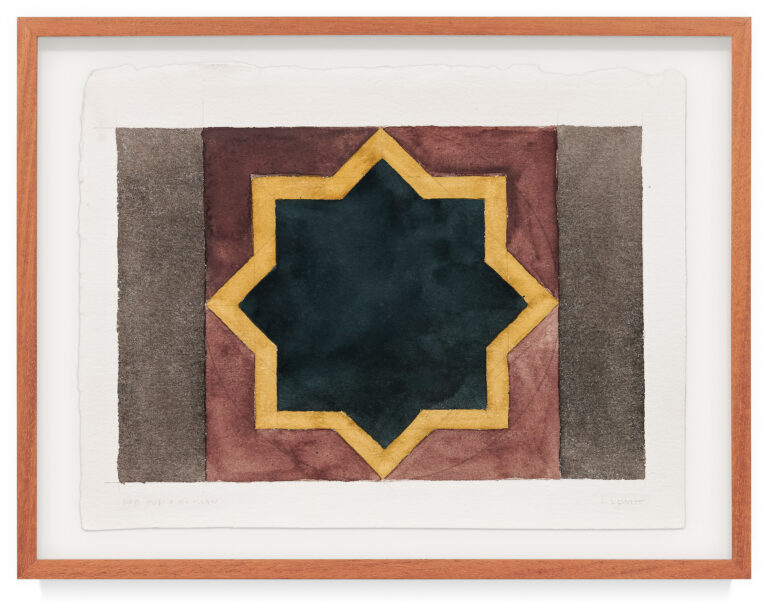
Eight-Pointed Star
1982
Ink on paper, unique

Image size: 6 3/8 x 9 5/8 inches (16.2 x 24.4 cm)
Paper size: 8 1/2 x 11 3/8 inches (21.6 x 28.9 cm)
Frame size: 10 3/8 x 13 1/2 inches (26.4 x 34.3 cm)
Signed lower right recto and dedicated lower left recto
(Inventory #40297)

Four Part Combinations of Geometric Figures in Four Colors
1980
Set of four woodcut prints

Image size: 4 7/8 x 14 1/2 inches each (12.4 x 36.8 cm each)
Paper size: 8 1/2 x 18 1/2 inches each (21.9 x 47 cm each)
Signed and numbered
Edition of 40, AP 2/10
(Inventory #38573)

Lines In Color on Color From Corners Sides and Centers to Specific Points on a Grid
1978
Set of nine silkscreens with cover sheet

Image/Paper size: 30 x 30 inches each (76.2 x 76.2 cm each)
Edition of 25
Signed and numbered lower right on each sheet in graphite
(Inventory #31038)

The Location of Six Geometric Figures: The location of a circle, parallelogram, square, trapezoid, triangle, and rectangle
1975
Etching with aquatint

Image/Paper size: 23 3/8 x 23 5/8 inches (60 x 60 cm)
Edition of 25
Signed and numbered lower right in graphite
(Inventory #37543)

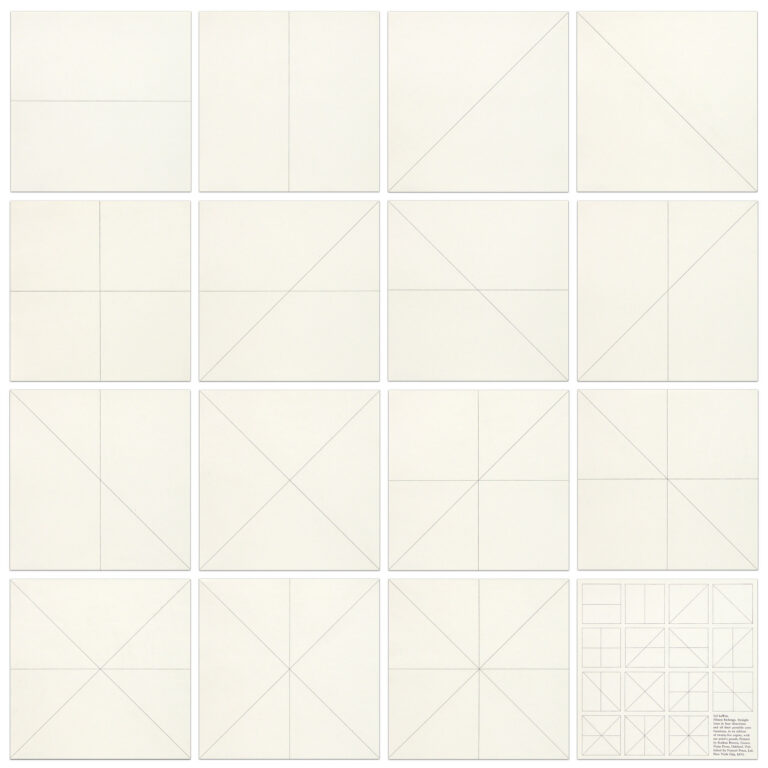
Straight Lines in Four Directions & All Their Possible Combinations
1973
Set of sixteen etchings

Image/paper size (each): 10 1/2 x 10 1/2 inches (26.7 x 26.7 cm)
Signed and numbered on reverse on each sheet
Edition of 25
(Inventory #40283)

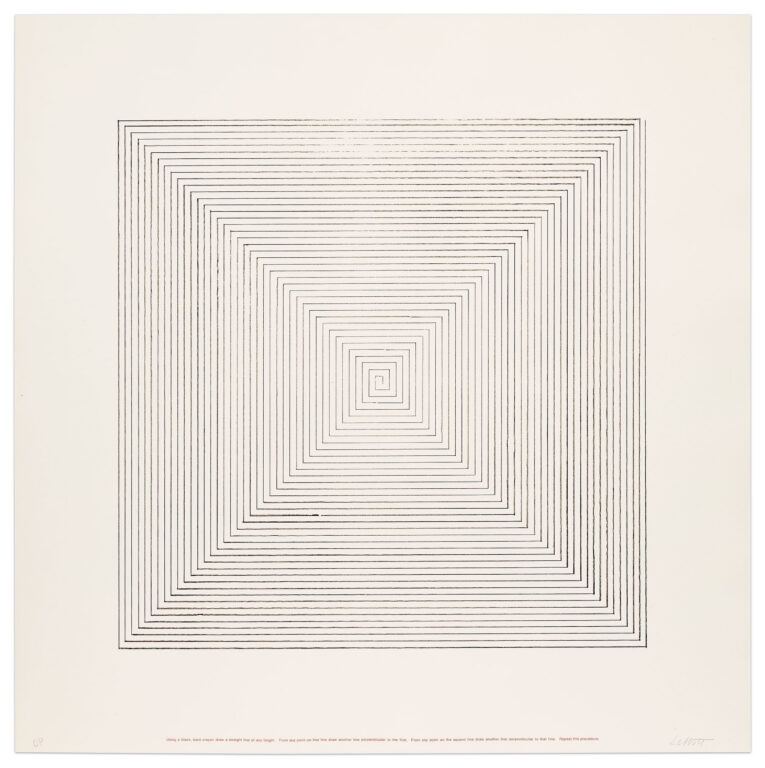
Work from Instructions
1971
Lithograph, using the following instructions:

“Using a black, hard crayon draw a straight line of any length. From any point on that line draw another line perpendicular to the first. From any point on the second line draw another line perpendicular to that line. Repeat this procedure.”
Image size: 23 1/2 x 20 inches (59.7 x 50.8 cm)
Paper size: 28 x 28 inches (71.1 x 71.1 cm)
Signed lower right and numbered lower left
Edition of 25, 5 AP, this being the “DP”
(Inventory #40332)

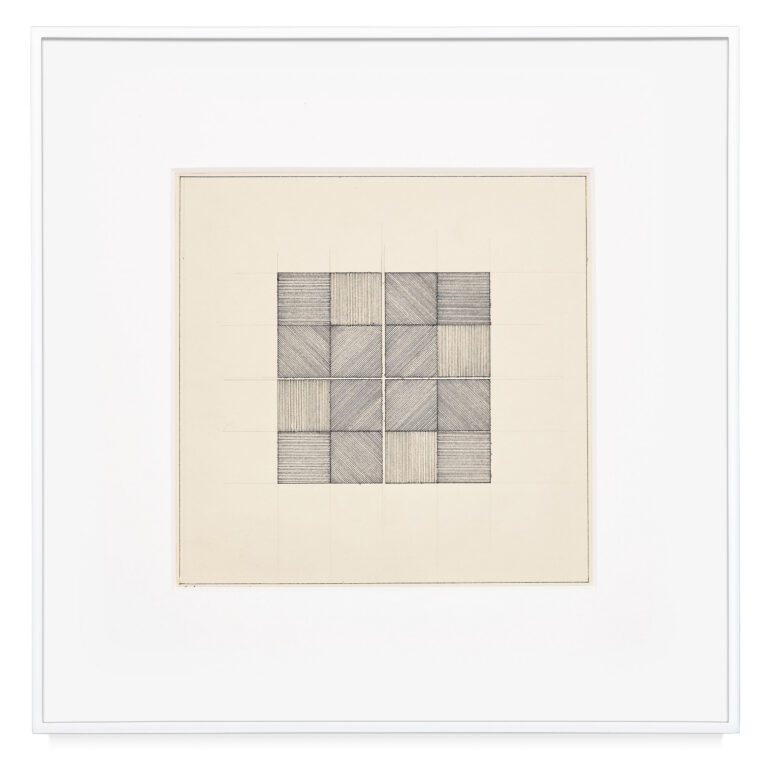
Drawing Series I, #10
1968
Ink and graphite on paper, unique

Image size: 4 /58 x 4 5/8 inches (11.7 x 11.7 cm)
Drawn border size: 8 7/8 x 8 7/8 inches (22.5 x 22.5 cm)
Paper size: 10 3/8 x 10 3/8 inches (26.4 x 26.4 cm)
Frame size: 15 1/4 x 15 1/4 inches (38.7 x 38.7 cm)
Signed, titled, and dedicated lower recto
(Inventory #37101)

Additional Information

Sol LeWitt was born on September 9th, 1928 in Hartford, Connecticut to Eastern European immigrants. His father, a doctor and inventor, died when he was 6. Soon after, he moved with his mother, a nurse, to live with an aunt in New Britain, Connecticut. His mother took him to art classes at the Wadsworth Atheneum in Hartford and he would draw on wrapping paper from his aunt’s grocery store.

LeWitt received a BFA from Syracuse University in 1949 (where he made his first prints) and then was drafted in the Korean War in 1951. During his service, he made posters for the Special Services and spent time in Japan, where he bought the first works that became the basis of a large personal art collection.

In 1953, he moved to New York City, where he studied at the Cartoonists and Illustrators School (now the School of Visual Arts) and worked for Seventeen Magazine, making paste-ups, mechanicals and Photostats. He was then hired as a graphic designer in I.M. Pei’s architecture firm.

In 1960, he took an entry-level job at the Museum of Modern Art, where he met Dan Flavin, Robert Ryman, Lucy Lippard and Robert Mangold. Together, through the Sixteen Americans exhibition, they were introduced to the work of Jasper Johns and Frank Stella and Robert Rauschenberg.

LeWitt was also interested in Russian Constructivism, with its engineering aesthetic and the idea of making utilitarian art in an industrialized age. However, the work that influenced him the most was Eadweard Muybridge’s serial photography, sequential studies of people and animals in motion, which he came across in a book that somebody had left in his apartment. LeWitt’s work from the early 1960s, works on canvas coated with thick gestural oil paint, each featured one of Muybridge’s figures in motion.

LeWitt’s three dimensional structural works from the mid to late 1960s such as Serial Project, Three Part Variations on Three Different Cubes, and hundreds of sculptures made of open white cubes – grew out of this interest in the serial. He applied the same system of permutations and variations in his prints, drawings on paper and drawings on the wall.

Sol LeWitt executed his first wall drawing in 1968 at Paula Cooper Gallery in New York. Like many of the wall drawings after this, Wall Drawing #1 consisted of a system of parallel lines drawn with black pencil on a white wall in four directions (vertical, horizontal, diagonal left, and diagonal right.) By drawing directly on the wall, the work’s duration was limited and ultimately the wall drawings are painted over. It also allowed him to achieve his objective of reinforcing flatness and making a work as two-dimensional as possible. Wall Drawing #1 also emphasized the premise of the artwork over the final product. In a 1969 article for Studio International, LeWitt wrote, Two-dimensional works are not seen as objects. The work is a manifestation of an idea. It is an idea and not an object. Without the traditional support of canvas or paper, wall drawings exist as a set of instructions and can be installed again and again.

This radical shift to drawing on the wall, followed the publication of Paragraphs on Conceptual Art, where he wrote, “When an artist uses a conceptual form of art, it means that all the planning and decisions are made beforehand and the execution is a perfunctory affair. The idea becomes the machine that makes the art.”

Although LeWitt drew Wall Drawing #1 on Paula Cooper’s gallery wall himself, he soon found that a team of assistants could oftentimes install his work better. He believed that the idea of his work superseded the art itself, as curator Andrea Miller-Keller said, “The essence of LeWitt’s work is the original idea as formulated in the artist’s mind.” He soon took this and applied it to the print medium through numerous projects with numerous techniques.

In the late 70s, shortly after his first retrospective the at Museum of Modern Art and after numerous years of exhibiting in Italy, LeWitt moved to Spoleto, Italy. There he saw frescos by Fillippo Lippi, Massaccio, Fra Angelico and Giotto’s in local churches, museums and convents. In 1983, LeWitt’s art underwent a major transformation and he began to experiment with India ink and color ink washes, a nod to the local Trecento and Quattrocento works. He acknowledged the influence of these masterpieces on his own drawings, and went so far to say, that in his work he strived to produce something [he] would not be ashamed to show Giotto.”

In the exhibition catalogue for Think with Senses Feel with Mind, Art in the Present, part of the 2007 Venice Biennale, Robert Storr wrote that LeWitt proved over and over again that the strict, systematic realization of a singular working premise is bound to produce results that will surprise both the maker and the viewer by exceeding expectation and giving eye-and-mind expanding physical dimensions to mental abstractions. Until 2033, LeWitt’s wall drawings are the subject of a solo exhibition titled Sol LeWitt: A Wall Drawing Retrospective at the Massachusetts Museum of Contemporary Art.

Sol LeWitt died in 2007 in New York City.

Rubber Stamp Portfolio: Carl Andre, Richard Artschwager, Daniel Buren, Chuck Close, Barry Le Va, Sol LeWitt, Agnes Martin, Robert Mangold, Sylvia Plimack Mangold, Don Nice, Myron Stout, Tom Wesselmann, and Joe Zucker

June 21
- July 18, 2025